
Some want to live within the sound of church or chapel bell. I’d rather run a rescue mission a yard from hell – C.T. Studd
POP. POP. POP. The rattle of gunshots erupted in the still night air. Here in West Garfield Park, Chicago, gun fire is a daily occurrence, but these shots were close. They sounded as if they are right outside. It was slightly past 2am and Curtis Thompson had just arrived home after a full day of working, mentoring, and ministering. This was home now. At the end of 2007, Michelle and Curtis had made the leap to put down roots into the most violent community in Chicago and moved into a two-hundred and ten year old house in the heart of the neighborhood. The home itself was beautiful, but forsaken, forgotten, and in need of loving hands to help restore it. Curtis and Michelle had come to do that for the home and with the help of God, the community as well. Inside the brick walls, though drafty and cold (she was more of a poncho when you needed a parka) held the heartbeat and love of a family. Mikayla, their oldest, was still merely a toddler that night and Jack Jack, their giant sheep dog, was a crazed bumbling pup. During the day you would find both scampering around the house with the playful energy of youth as the home’s old skeleton moaned and groaned like a cranky grandpa. All of these irreplaceable treasures were on Curt’s mind as he cautiously hurried to see where the gunshots were coming from. He snuck up to the large bay window that sat at the front of the home immediately to the right of his front door and peeked out. There on the sidewalk in front of his house lay a young man clinging desperately to life. He seemed to be weakly attempting to crawl. As Curt watched, his mind spinning over what to do, a second man suddenly appeared from out of the darkness. He saw a flash of metal in his hand. A gun! Curt watched helplessly as the assailant ran up to the young man on the ground, pointed the gun at his head and pulled the trigger. POP. POP. Two fatal shots. Just as quickly, the killer disappeared back into the shadows. The street lamp cast a pale yellow glow on the now lifeless body that lay no more than twenty feet from Curt’s front door. His last precious breaths on this earth were spent utterly alone, sprawled out on the cold, hard pavement of a city street. No one deserves this, was the singular thought that coalesced in Curt’s mind. No one deserves to die alone! This is West Garfield Park. This is why the Thompson’s came.
. . . . . . . . . . . .

Nowhere in Chicago is more dangerous than West Garfield Park. Here, in this tiny 1.294 square miles neighborhood located about 6 miles from downtown Chicago live a little more than 18,000 people.[1] That total makes it one of the smallest neighborhoods in the Chicago metropolis, yet almost yearly it ranks as number one in both “violent crime rates,” and “quality-of-life” crime rates as measured by the Chicago P.D.[2] In fact, in “quality-of-life” crimes (such as narcotics and prostitution) it outranks the runner-up neighborhood, Lawndale, nearly 3 to 1. It is one of the least diverse districts in Chicago, with African Americans consisting of 97.3 percent of population and is also one of the poorest neighborhoods in the city. Nearly 50% of the inhabitants are below poverty level and it ranks 73 out of 77 Chicago neighborhoods with a median household income of only 23.5k per year. 48.7% of the neighborhood is on government assisted food stamps. A deeper dive into the statistics paints an even bleaker picture. Only 48.6% of working age males (35-44) are employed. The average for Chicago total is 84.1%. Males employed aged 30-34 in West Garfield is even lower with only 24.6% of them working contrasted with a city wide average of 80%. Many males don’t even make it to 35. While West Garfield has one of the highest percentage in the city of 5-9 year olds and 20 years old making up its total population, it has the lowest percentage of 35-39 year olds in its population of the entire 77 individual communities that make up Chicago.
The simplest reason for this discrepancy is crime and violence. 62,500 males entered Cook County Jail in 2011 alone.[3] 63% were aged 35 or younger, almost 70% were African American and nearly 20% of the total were from the West Side of Chicago, an area that includes 9 of the 77 Chicago communities including West Garfield Park. When you crunch the numbers, you find that roughly 18% of all black males in West Side Chicago, age 15-34, are admitted to jail each year. Approximately 480 young men out of 2667 in West Garfield Park are processed and booked each and every year. That number is literally double the average in America as a whole. “Violent” offenses followed closely by “Drug” offenses make up the vast majority of crime committed by incoming inmates. West Garfield Park is Chicago’s leader in both and each are dark and sinister paths that take young men towards death. In just 2013-2014, 31 males age 35 and younger were murdered in West Garfield Park. To put that into perspective, that is nearly as many murders as occurred the ENTIRE year in South Dakota, North Dakota, or Maine.[4]
Gregory McKinney (25) was shot at a restaurant in the early evening of November 5th, 2014 in the back and the head. He was dead within the hour. Doug Chambliss (32) was shot on the morning of November 3rd, 2014. Police found him lying face down on the grass when they arrived. Eddie Taylor (22) was at a late-night party at a local beauty salon when a man became enraged at not being allowed to enter, pulled a gun and started firing. Eddie was shot in the face and died instantly. The list goes on. Brian Davis (33) was shot in the back at 7:20pm on a Sunday. He died shortly thereafter. Jordan Harris (24) was caught in the crossfire at a party in the wee hours of the night. He was shot in the head and died instantaneously. Xavier Tripp (25) was shot on a street corner at 1:37 in the afternoon. In a “gang-related” incident, two men jumped out of a dark colored mini-van, shot Xavier multiple times, got back in the car, and drove off.
Each name and each story represents a life. A life that is gone. A life that was taken. A life that matters. But that is too simplified for some. Much of the violence that occurs is centralized on gang or drug related activity. From the outside it is easiest to view this as bad guys killing other bad guys. It makes us feel secure in our disinterest and content in our apathy. Yet on the street, in the homes, at the schools, you have 18,000 souls who live and breathe the same as everyone else. Men and women, boys and girls within a community where violence, drugs, and gangs feed off despair and desperation. Rinse and repeat. So what is the answer to the problem? Is there an answer?
Education must be part of it. The great hope of America is that education can help lift our children above our current generation’s problems. Yet the city of Chicago has been furiously trying this for decades. Billions and billions of dollars are spent every year to shape and change the future but it has done little to arrest the decay of West Garfield Park. In fact, it is failing spectacularly. In 2013, 5 schools in Garfield Park, all ranked by the Chicago Public Schools (CPS) as level 2 and level 3 were shut down. (The CPS releases a very complicated and nearly indecipherable rating system for all its schools every year defined as Level 1 – the Best, Level 2 – the Good; and Level 3 – The Ugly) A quick glance at West Garfield Park’s numbers seems to show that the city is succeeding in providing education to the area. The high school graduate rate is only a few percentage points off from the Chicago average with a majority of residents (62.6%) having a High School diploma. The problem is the quality of that education for West Garfield graduates. Many kids are shuffled through school and passed to satisfy quotas and maintain sufficient numbers, not that the numbers are impressive. Virtually all students within West Garfield Park go to free public schools rather than the better charter schools. The statistics tell a dismal story.


Two of the High Schools serving West Garfield Park are Manley High School and Orr High School. Manley High School is located in the North Lawndale neighborhood, West Garfield Park’s southern and eastern border community. It is fairly small having an enrollment of only around 500 students, is a level two school and has an impressive teacher to student ratio of 11:1. Unfortunately 22% of students drop out after one year and many others are simply kicked out or not allowed to come. In 2014, 21 out-of-school suspensions were leveled per every 100 students city wide. At Manley High School, the number is 172.9. Meaning there were LITERALLY 73 more out-of-school suspensions handed out that year then there were children at the school![5] Not surprisingly the academic achievement numbers reflect those trends. Zero percent of the school exceed the standard on the state’s Prairie State Achievement Examinations. Only 7% met the Mathematics minimum standard and 13% met the Reading minimum standard. A staggering 93% of the school failed in Mathematics and 87% in Reading.[6]
Orr High School is even worse. Located on the north edge of West Garfield Park, Orr High School is a level 3 school. It has one of the lowest average attendance in the city of just 77.9% of its students, almost 1/4th of students drop out after one year, and while Manley had a staggering number of out-of-school suspensions at 173, Orr’s is a full 25 more at 198 suspensions per 100 children. Unsurprisingly, 99% of the students fail to meet the state standard in Mathematics and 90% are failing at Reading. But they continue to get pushed through. Michelle shared what a great tragedy this is for the students, “One of the girls I work with, [she] graduated and her reading level is lower than my 7 year old son…and [the school] kept saying ‘Awesome! You Pass!’…Come to find out that when she is trying to get into college [the college tells her], ‘You cannot get into college. You must do 3 years of preparatory college…basically, you have to redo High School all over just to get into College. How discouraging for her.” The numbers reflect in the community. A measly 609 (6.2%) residents have a bachelor’s degree in the entire community. There is a great necessity for the quality of education in West Garfield Park to improve and a great difficulty on how best to do that. But maybe we need to stop and ask ourselves, even if it does improve, will that be the answer? Is more quality and quantity of education the factor that can redeem West Garfield Park? Michelle is unsure, “We continue to throw money at it and believe that this will be the great saving of our city.” But is there something more at work here? Something deeper? Something more fundamental?
Perhaps it is poverty. Maybe if we could just find ways to productively and responsibility pump funds into trouble neighborhoods such as West Garfield Park than we could essentially “buy” the solution. Chicago does this now. They provide massive amounts of funds in the form of community and governmental programs or focused legislation. The most vanilla form is governmental food stamps. West Garfield Park is top 6 in Chicago for the percentage of its inhabitants on food stamps (48.7%). So does this help? To a point, of course, a meal in the richest country in the world should be everyone’s right. But when charity becomes a right, when what should be done willingly and as a gift becomes forced and a tax, both the giver and the receiver loses. The giver loses the joy and pleasure of giving, and the receiver loses the sacredness of receiving an undeserved gift and the gratitude that the gift is only because of the kindness of others. So what was meant for good and sacred is common and defiled, and the roots of entitlement are found.[7] Food stamps, likewise, have now created a black market. Many times individuals that receive food stamps use them, not to buy food for themselves or for their children, but to trade for alcohol or drugs. Money meant for good instead ends up fattening the drug dealers and the pimps.
The city tries other ways. There are disability benefits and unemployment benefits. There is money for families below the poverty line in the form of various state programs such as WIC, Illinois Temporary Relief for Needy Families (TANF), Illinois Low Income Home Energy Assistance Program, and Illinois All Kids (CHIPRA) to name a few. There are housing units for low-income families available based on income. A beautiful idea in theory yet a disaster in reality. Even the mere mention of its name over the last 60 years immediately conjures images of danger, crime, and hopelessness: the projects. There is child support for impoverished families with children. Each child you have gets you more money, in fact the money from child support on average equals 52% of that family’s income. Nearly 1 in 4 children in Illinois receives child support.[8] All these programs, right now and for years, have been functioning and relocating money into West Garfield Park. So have they worked? Well, the simple answer is no. The percentage of residents in poverty in 2000 was 36%. Eleven years later in 2011, that percentage had actually grown to the dizzying level of 43%. It is now estimated to be at 48.7%. They are failing miserable.
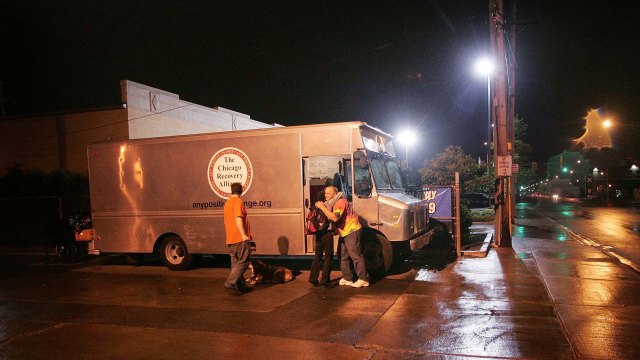
Sometimes the city doesn’t even attempt to address the problems anymore but just the consequences. There is a van run by the Chicago Recovery Alliance that runs a needle exchange. The Alliance allows any drug addict to come to the van and exchange dirty needles for clean ones and gives out free cookers, cotton, sterile water/saline, alcohol pads and ties, all the necessities for your drug of choice. It also freely gives out condoms.[9] Both of these measures are designed to try and lessen the impact HIV/AIDS is having on neighborhoods such as West Garfield Park. There is even a store front within the community that gives away condoms in the hopes of instilling “safe” sex. The pimps and their prostitutes find it a welcome hub of activity. Since all these programs seem to do little to slow the problem, TPAN, Chicago’s HIV Agency, operates a mobile testing site. Basically a small food truck, this clinic on wheels slowly meanders it way around the neighborhood offering free AIDS tests and handing out even more condoms. A rolling personification of a society unaware of how to stop the crisis.
When giving money to the residents fails, the city spends it on the enforcement. Mayor Rahm Emanual swept into office in 2012 on the back of promises to add 1,000 more police to the Chicago force. If you can’t fix the problem, hire more “good” guys. Unfortunately the money wasn’t there and now, five years later, the city is embittered in scandals over police brutality and corruption. Even further back, the city invested in a new network of cameras starting in 2003 for Humboldt Park and West Garfield Park. In 2006, after almost 6.8 million dollars had been spent, the crime levels in West Garfield were and remain as high as ever.[10] The hustlers and sellers just moved to the other street corners without cameras. Unable to corral the violence through these measures, Chicago has also tried to legislate crime away. Some of the strictest gun laws have been introduced and passed. Until recently Chicago was in practice a “gun-free” zone with residents unable to conceal carry and various legislation enacted by infamous Mayor Daly making it nearly impossible to even own a gun. The result? Gun-related incidents in Chicago continued to be some of the highest in the country every year. Shooting incidents just this year are on pace to nearly double last year’s total.[11] All proving, not surprisingly, that criminals care little about laws.
More worrying is the fact that money, education, and legislation have all failed to correct the ills of West Garfield Park. Can anything correct them? How do you change a seemingly unchangeable cycle of poverty, death, and destruction? How do you starve a monster that now feeds off the very institutions designed to defeat it? Most importantly, is the violence, the poverty, the HIV crisis, the sex trade, the sexual violence, etc., of West Garfield Park all sources or symptoms of the problem? Is each an individual issue that must be dealt with or is there one main underlying cancer that causes all the tumors? In other words, does West Garfield Park have a bunch of spots or does it have leprosy?
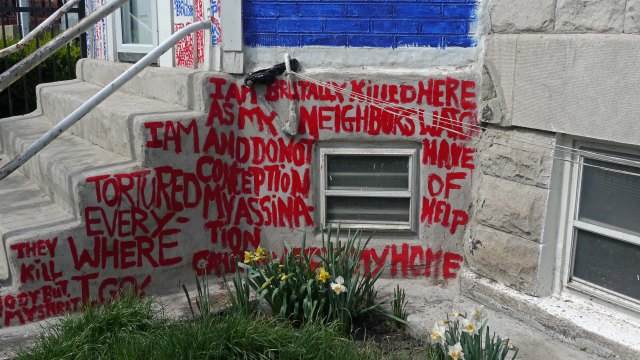
Society tends to look at West Garfield Park and its diseases of violence, drugs, prostitution, gangs, and poverty like a math equation. If we can just find the right formula than we can solve the riddle. If we add this, subtract this over here, and multiply it all by money than we can make it come out all right. But what if the assumptions are all wrong? What if what we think is absolute is not at all, and no matter how hard we try, one plus two will never equal three? The basis of most governmental programs is that education, money, and resources are the fundamental elements of change within society. This view has driven the programs and the legislation for decades to right the wrongs of communities like West Garfield Park. But they haven’t worked and continue to fail year after year. Why? I decided to ask Michelle. What did you see as the problem with West Garfield Park and even more vital still, why had she come here? What did she think she could do to fix what is broken?
“We were never under any delusion,” she began with a knowing chuckle, much as a mother would if you asked her how she knew her children were lying, “that we would be able to fix anything that is wrong with Garfield Park. The problems are insurmountable.” Well, that is reassuring, I thought somewhat sarcastically. “Insurmountable,” is a strong word. What was at the bottom of these ills that Michelle felt that secular society couldn’t defeat? I decided to just come out and ask it bluntly, “Michelle, what do you find is the main problem of West Garfield Park?”
She paused and took in a deep breath, “Well, I believe it is sin. It is people that live in sin and people that love sin…Our people are enslaved to a mindset and to a lie. They are ignorant of the truth and they relish in the lies in which they live. So, it is not even that they hate [their sins], they love them. So we must teach them to forsake that which they love and to love that which is good. And to discern good from evil. ”
I smiled slightly to myself as I listened to Michelle passionately speaking. I thought of a politician saying something like that. The backlash and the anger would be immense. The idea that the issue at the bottom of the barrel is a spiritual problem is offensive because it is so personal. How odious to think that no amount of diets, self-help books, community programs, or new leaves will ever fundamental change you or me? The idea of sin lays bare our faults and confirms our consciences. It makes us humbly have to admit that the real issue with life is not, them and they, but ultimately, me and I. G.K. Chesterton wonderfully modeled a humble response to the reality of sin in a famous letter to the Editor he wrote answering an article run by The Times entitled, “What’s wrong with the world?” He gave this poignant response:
Dear Sir,
I am.
Yours, G.K. Chesterton
Still, the idea of sin also points fingers and tells us we have a problem, and no one likes to be told they have a problem. Richard Dawkins in his work The God Delusion displays a typical secular response to the notion that we should be held accountable to a moral code for our actions. From his perch atop a tenured position at Oxford University he expounds that, “the Christian focus is overwhelmingly on sin sin sin sin sin sin sin. What a nasty little preoccupation to have dominating your life.”[12] Yet, in Michelle’s neighborhood, men and women live out the reality of what Richard Dawkins is proposing, lives without the restraints of any precocious ideas of moral right and wrong. The results are devastating.
“Our people live shameful lives,” Michelle continued, “and they just relish in the glory of it. They highlight the profane…Nothing is shocking. Nothing is over the line. Nothing is obscene…There is no shame in anything…Nothing sacred at all…There is no value to anything. Everything is just devalued…even the most sacred things have been corrupted…[So many in our community] live for the flesh, for the satisfaction of their flesh, to the destruction of even their own bodies…I mean we have a little cart that just wheels it’s way around our community and checks for AIDS…we have the little store front that says, “Free Condoms,” and in walk all the prostitutes and all the pimps…and then we have the little cart that comes through with clean needles. We won’t even address the fact that your flesh has been so corrupted by blow or whatever else you have been using, but here, at least will you use a clean needle. [All of this is such] a sad commentary on our times. We just really don’t know as a nation what to do about this problem, when there is a people that relish in their shame and glory in it.”
If the problem at the bottom of West Garfield Park’s most pressing issues is fundamentally an issue of the heart, then a different type of solution is needed. One that will target the type of internal and lasting change that will drive an external revolution. I thought back to the word “insurmountable” again and a story from the bible flashed to mind. Matthew tells the story of Jesus and his encounter with a young man. Jesus had just finished a conversation with this powerful, young, and rich ruler and the answer he had given to the ruler’s question had troubled both the young man and Jesus’s followers. The standard of moral requirement that Jesus called people to seemed so hard that it prompted his followers to ask, “Can anyone be saved?” In other words, salvation seemed “insurmountable” to the disciples. Christ gave his disciples the same answer Michelle gave me, “With man it is impossible. But with God, all things are possible.”
“We are not going to save anyone with a program or a project,” Michelle revealed. “We stress a personal relationship with Jesus Christ…When your mind is enslaved you need someone to unlock it and set it free. You can’t be shoved into the truth. You can’t be forced to change. Behavioral modification works for a moment, but when rehab is done and you check back out to the streets, we have habits and patterns and we are a sinful creation. We believe we need a transforming work from our heart. We need a heart change. We need a mind change…We believe in the power of Christ [to do this]. He can come into a life, transform it, bring freedom, and restore and renew. We want change on a mind and a heart level, and we believe that will change a life.”
This “change on a personal level,” is tantamount to Michelle and Curt’s ministry. It stems from their view of sin. If the core of the problem is personal, then lasting change must come from the ground up. No amount of top down programs or legislation will ever fix an internal, ultimately spiritual, problem. The sticky issue with this view is that it involves a level of commitment and personal investment most don’t want to make. It also requires a belief that the power of God is needed to impact and successfully transform a person. For many, this idea is troublesome, even un-American. We like to pull ourselves up by our own boot straps, thank you very much. And yet, we are left with a dilemma. West Garfield Park and neighborhoods like it, despite our best efforts, remain. We haven’t found a solution. What if it is sin at the source? What if the power of Christ is needed? What if that is the truth? How could you even prove it? Would there be an objective way to demonstrate if this God thing works? Yes and yes.
The pudding. That is where the proof is. As I listened to the Thompson’s story unfold I realized that the grandness of Michelle and Curtis’s tale are the stories of others changed and impacted through their ministry at Reborn Community Church. For within those changed lives is the evidence of the power of God and the redemptive work of a Savior. The proof is in the life of a teen named Brianna. It is in the life of a gang leader named Clarence. It is in the life and death of Martel. It is in the hearts of children named Tashelle and Rodell. It is in the transformation of Sharon. It is in the members and visitors of Reborn Community Church. It is in the single lives that are different, changed, renewed, and transformed by a relationship with Christ. It is in the families impacted by the love and hope of local followers of God. The evidence lives across the concrete streets, behind the iron fences, and within the brick buildings of West Garfield Park. It sleeps on W. Monroe St and W. Van Buren St. It plays at the fire hydrant on W. Wilcox St. It goes to school on S. Kostner Ave.
Maybe these concepts of sin and Christ are foreign to you. Maybe they are offensive to you. I hope you will look at their power objectively. We must not diminish the reality and the victory of these men, women, boys, and girls and their lives. We must honor and support each for striving and working towards breaking the cycles of destruction so prevalent around them. We must not flippantly dismiss how faith in Christ has helped them find freedom from addictions, or given them the strength to choose a better way for their future. We must be open to the proof that there is something good, something wonderful at work that has nothing to do our human hands. You will find no fairy tales here. There will be heartache, failure, and destruction, but there will also be hope, forgiveness, and victory. This is real life. You will see a peace that surpasses all understanding resonating in the life of Michelle and Curtis. You will find acts of boldness in the face of danger and gentleness in an arena of violence. You will witness hearts and hands that give freely. You will find souls and spirits that are resolute. You will see joy in the darkest of storms and hope when all is lost. And there in the middle, like a lighthouse for those desperate and lost at sea, will be a God that is faithful and a Savior that is as near as a whisper. Then, after you have read and heard of these lives, maybe the finally proof you will discover, the last evidence of the work and need for a Savior will not be in the city of Chicago, nor in the neighborhood of West Garfield Park, nor in the lives of its residents, but in the place most sacred to you, the place most important to you: your very own heart.
- And I will give you a new heart, and I will put a new spirit in you. I will take out your stony, stubborn heart and give you a tender, responsive heart.
– Ezekiel 36:26 NLT
[1] Cook County is the county where Chicago is located. Unless otherwise marked the following statistics are from http://statisticalatlas.com/neighborhood/Illinois/Chicago/West-Garfield-Park/Overview which provides a fantastic visual and systematic breakdown of the most recent census information.
[2] http://crime.chicagotribune.com/
[3] The following jail statistics come from the helpful report by David E. Olson, Population Dynamics and the Characteristics of Inmates in the Cook County Jail, Loyola University Chicago, 2012. This report is found at http://ecommons.luc.edu/cgi/viewcontent.cgi?article=1000&context=criminaljustice_facpubs
[4] http://homicides.redeyechicago.com/neighborhood/west-garfield-park/#homicide_link_4457021. See http://www.disastercenter.com/crime/ for statistics per state.
[5] http://cps.edu/Schools/Pages/school.aspx?SchoolID=609722
[6] http://www.usnews.com/education/best-high-schools/illinois/districts/chicago-public-schools/manley-career-academy-high-school-6585/test-scores
[7] For a far superior analysis see Chapter 9 of D’Souza, Dinesh. Letters to a Young Conservative. New York: Basic Books. 2002. Print.
[8] http://www.childsupportillinois.com/assets/IllinoisPreliminaryReport.pdf
[9] http://www.thebody.com/content/art1163.html. They hand out ascorbic acid because it allows crack to be dissolved so users can shoot it up easier. How sweet of them.
[10] http://www.urban.org/sites/default/files/alfresco/publication-pdfs/412401-Evaluating-the-Use-of-Public-Surveillance-Cameras-for-Crime-Control-and-Prevention-A-Summary.PDF
[11] http://chicago.cbslocal.com/2016/02/01/chicago-shootings-murders-crime-january/
[12] Dawkins, Richard. The God Delusion. New York: Houghton Mifflin. 2008. Pg. 285
 bglenney
Excellent post. This is something I would expect to read in like a Christian version of The Atlantic. The writing quality is very high and the research is insightful. I look forward to reading Part 2!
LikeLike
Thanks Joel! I appreciate the kind words.
LikeLiked by 1 person
Amazing Grace! Amazing God! Sometimes we forget that God is bigger than any hardship here! Thank you for sharing.
LikeLike
Your welcome, and Amen!
LikeLike